Gettit vs. Tinder: Why Verified Users Change Everything
November 24, 2025 — By Gettit Team · 10 min read
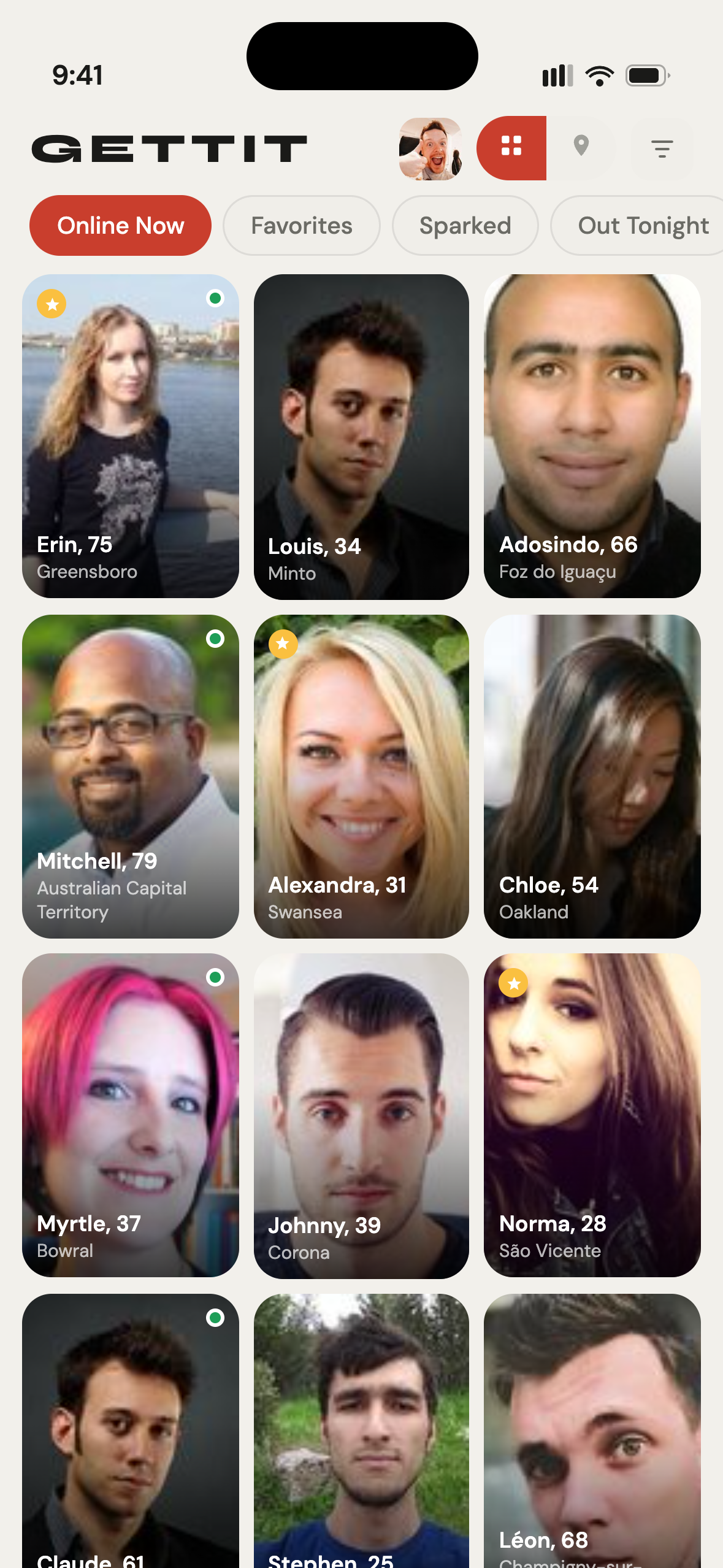
If you’ve ever spent a weekend on Tinder only to discover that half your matches were bots and the other half never replied, you’re not alone — and you’re not imagining it. The search for a tinder alternative with no fake profiles has driven a wave of users toward newer apps that take verification seriously from the start. This piece compares Gettit and Tinder across five categories that actually matter: verification, pricing, discovery, ghosting, and safety. The goal is a fair assessment, not a takedown.
Verification: Optional vs. Mandatory
Tinder has offered “ID verification” as a feature since 2023. The catch: it’s optional. The vast majority of Tinder profiles were never verified against a real identity document. You can create an account today with a name that isn’t yours, photos scraped from someone else’s social media, and a throwaway email address. If no one reports the profile, it stays in the swipe stack indefinitely.
Gettit takes the opposite position. Identity verification isn’t a badge you can choose to earn — it’s a requirement before your profile is visible to anyone. New users submit a live selfie that is matched against their verified identity. If the check doesn’t pass, the account doesn’t go live. There is no shortcut and no bypass.
The practical difference is significant. On Tinder, “verified” means one specific person chose to take an extra step; on Gettit, it means every person in your grid passed the same gate before you ever saw their name.
Pricing: What You Actually Get at Each Tier
Tinder’s free tier is the experience most people complain about: limited swipes, no ability to see who liked you, and a feed packed with bot and ghost accounts that don’t filter out even after you report them. To get meaningful features, you’re looking at Tinder Gold at roughly $29.99/month or Tinder Platinum at higher price points still. The value proposition for those prices is debatable when unverified profiles remain at every tier.
Gettit has no free tier. Every user pays, and that structural choice matters: bot farm operators need cheap or free account creation to make their operations economically viable. When every account requires a real payment method in addition to identity verification, the incentive to run fake profiles collapses.
Gettit Base is $0.99/month. That includes full messaging — reactions, mentions, threads, GIFs — a verified proximity grid, the Response Rate Badge, and location fuzzing for privacy. Gettit Plus is $9.99/month and adds Incognito Mode, Video Intro, read receipts, typing indicators, voice messages, disappearing messages, AI icebreakers, message translation, and advanced search.
At $0.99/month with full messaging and zero fake profiles, Gettit Base undercuts Tinder’s free tier on quality while costing less than most people spend on a single coffee.
Discovery: Algorithm vs. Proximity Grid
Tinder’s core mechanic is an engagement-driven algorithm. Profiles that generate more right-swipes get shown to more people, which means conventionally attractive or highly optimized profiles dominate the feed regardless of how serious those users are about meeting anyone. The system rewards engagement, not intent.
Gettit’s proximity grid shows people near you in distance order. There’s no ranking algorithm deciding whose face you see first. Users who are 0.4 miles away appear before users who are 2 miles away. That’s it. If someone is nearby and verified, they show up. The result is a discovery experience that feels grounded in reality rather than gamified to maximize screen time.
For users who actually want to meet someone in person, a proximity grid has a natural advantage: the people you’re seeing are genuinely close to where you are right now, which removes a layer of friction between a match and a real-world meeting.
Ghosting: No Mechanism vs. Accountability by Design
Tinder has no mechanism to discourage ghosting. You can match with someone, never send a message, never respond to their message, and the platform will keep serving you new profiles with zero friction. From a pure behavioral design standpoint, there’s no cost to ignoring people.
Gettit addresses this through the Response Rate Badge — a visible metric on every profile that shows how reliably that person responds to messages. It doesn’t force anyone to reply, but it creates social accountability: users who consistently ignore messages have a visible track record, and users who respond consistently are recognized for it. Before investing time crafting a thoughtful message, you can see whether this person tends to respond. This is one of the core reasons Gettit functions as an anti-ghosting dating app — the accountability is built into the platform, not added as an afterthought.
This is a structural shift, not a feature you unlock at a higher tier. Every Gettit Base user has a Response Rate Badge on their profile. The aggregate effect is a culture where responding is the norm rather than the exception.
Safety: Volume vs. Verification
Tinder has had well-documented safety incidents. Catfishing is endemic because there’s no verification requirement. Assault cases involving Tinder matches have received significant media coverage over the years, and the platform’s own safety resources acknowledge that it cannot confirm the identities of its users.
Gettit’s position is structurally different. Because every user was verified before their profile went live, every match is a real person with a real identity on file. That doesn’t make human behavior perfect, but it changes the calculus considerably. A verified user knows that their identity is associated with their account. That accountability layer has a measurable effect on behavior.
Location privacy is also handled differently. Gettit never shares exact coordinates — the proximity grid uses fuzzing to show approximate distance without pinpointing a user’s location. Tinder has historically been more granular about location data, a detail that matters particularly for users in situations where their exact location shouldn’t be shared with strangers.
The Honest Assessment
Tinder’s genuine advantage is scale. It has tens of millions of monthly active users across hundreds of cities globally. If sheer volume of options is your priority, Tinder delivers that. In the largest metro areas you’ll find more profiles, more activity, and more choice — alongside significantly more noise, bots, and ghost accounts.
Gettit is launching its beta in New York City in April 2026. The user base will be smaller than Tinder’s for the foreseeable future, and that’s a real trade-off. But smaller doesn’t mean worse when the underlying quality is dramatically higher. A grid of 200 verified people who are genuinely nearby and likely to respond is a more useful dating experience than a feed of 10,000 profiles where you can’t tell who’s real.
If you’re serious about actually meeting someone and you’ve spent enough time on Tinder to know what you’re working around, Gettit is worth trying. For a deeper look at how verification stacks up across platforms, see the full guide to dating apps with verified profiles. If you’re also comparing Gettit against other apps, see Gettit vs. Hinge. Sign Up Now — it’s open now in NYC, and beta testers receive Gettit Plus free for six months.
Ready to Meet Real People?
Join the Gettit beta and get 6 months of Plus free.
Sign Up Now — 6 Months Free