The Safest Dating Apps for LGBTQ+ Users in 2026
December 22, 2025 — By Gettit Team · 10 min read
For most people, a bad dating app experience means wasted time or a disappointing date. For LGBTQ+ users, the risks are categorically different — and finding a safe LGBTQ+ dating app requires asking harder questions than most review sites bother to answer. Outing risk, targeted harassment, physical safety in meetups, and the quiet but serious question of what happens to your data after you delete your account. These concerns shape which apps are worth using and which ones ask too much of you in exchange for too little.
Why Safety Is a Different Conversation for LGBTQ+ Users
Straight users on dating apps face real risks — scams, catfishing, harassment, and the occasional creep. LGBTQ+ users face all of those, plus a set of risks that don’t apply the same way to cisgender heterosexual people.
Outing risk is the most specific and severe. In many parts of the United States and across much of the world, being outed as gay, trans, or queer carries real consequences — job loss, family rupture, housing insecurity, and in some regions, criminal liability or physical violence. An app that leaks your location data to a precise radius, or that associates your identity with your orientation in a data breach, can cause harm that a bad Tinder date simply cannot.
Targeted harassment follows a pattern on LGBTQ+-specific apps that differs from general harassment. Users can face coordinated abuse, outing campaigns, and entrapment by people who join the platform specifically to harm queer users. This isn’t rare, and the moderation systems on many apps aren’t built to catch it quickly.
Physical safety in meetups is heightened because of both the risk of violence and the risk of encounters with people who misrepresent themselves. Catfishing on a queer app carries additional danger because the person doing the catfishing sometimes has hostile intent beyond simply deceiving a match.
Any serious evaluation of a safe LGBTQ dating app has to account for all of this — not just whether the app has a block button.
What “Safety” Actually Means in a Dating App Context
Before comparing apps, it helps to define the four dimensions of safety that matter most:
1. Data privacy. Does the app sell or license your orientation, location history, or usage data to third parties? Has it experienced data breaches? How long does it retain your data after you delete your account?
2. Identity visibility controls. Can you control who sees your profile? Can you hide your profile from people you know in real life? Can you browse without being seen?
3. Moderation quality. How quickly are harassment reports handled? Is there 24/7 moderation? Does the platform ban repeat offenders or just their current account?
4. Verification. Are the people you’re matching with who they claim to be? Is there any mechanism to distinguish real people from bots, scammers, and bad actors before they reach your inbox?
Grindr: High Reach, Documented Privacy Issues
Grindr is the dominant app for gay and queer men, and its reach is genuinely useful — it has users in more cities and countries than any competitor. But its safety record is one of the worst in the industry. For a detailed head-to-head breakdown, see the full comparison of Grindr vs. Gettit.
In 2018, it was revealed that Grindr was sharing users’ HIV status with third-party analytics firms. In 2020, it was acquired and then re-sold under circumstances that raised serious national security concerns around user data. In 2023, a Norwegian data protection authority found Grindr had illegally shared user data with advertisers. Location data on Grindr has historically been displayed at a precision that makes triangulation attacks — using fake accounts at known positions to narrow down a user’s exact location — straightforwardly possible.
Grindr has taken steps to improve its privacy practices, but its track record creates a reasonable trust deficit for users whose safety depends on discretion. There is also no meaningful identity verification — the bot and scam rate on Grindr is among the highest of any major dating platform.
Scruff: Better Reputation, Still No Mandatory Verification
Scruff occupies a different position in the market: its ownership has historically been more privacy-conscious, and the platform hasn’t had the same high-profile scandals as Grindr. It offers some additional profile controls and has a more engaged moderation approach.
The limitation is that Scruff has no mandatory identity verification. Accounts are easy to create anonymously, and while the community culture tends toward more genuine engagement than Grindr, the structural protections against catfishing and bad actors are limited. Scruff is a better choice than Grindr on privacy grounds, but it’s operating on community norms rather than technical safeguards.
HER: Focused on Women and Nonbinary Users
HER serves a more specific community — women and nonbinary people — and benefits from a tighter community culture that filters out some of the harassment dynamics common on apps with a large cisgender male user base. For its target audience, it offers a meaningfully safer social environment than broader-audience apps.
The tradeoffs are smaller user base (which matters most in less-populated areas) and limited verification infrastructure. HER has face-check features but not full identity verification. If you’re a woman or nonbinary person who lives in a city with an active HER community, it’s worth having on your phone alongside any other app you use.
Taimi: Verification Available at Premium Tier
Taimi is an inclusive LGBTQ+ platform that offers identity verification — but only as a premium feature rather than a requirement. Users who choose to verify get a badge, but the majority of the user base remains unverified. This is better than no verification option at all, but “optional” verification doesn’t change the baseline trust level of the platform the way mandatory verification does.
Gettit: Built Around Mandatory Verification and Privacy
Gettit is newer and currently in beta in New York City, but it approaches safety at a structural level that other apps don’t match. Some specifics:
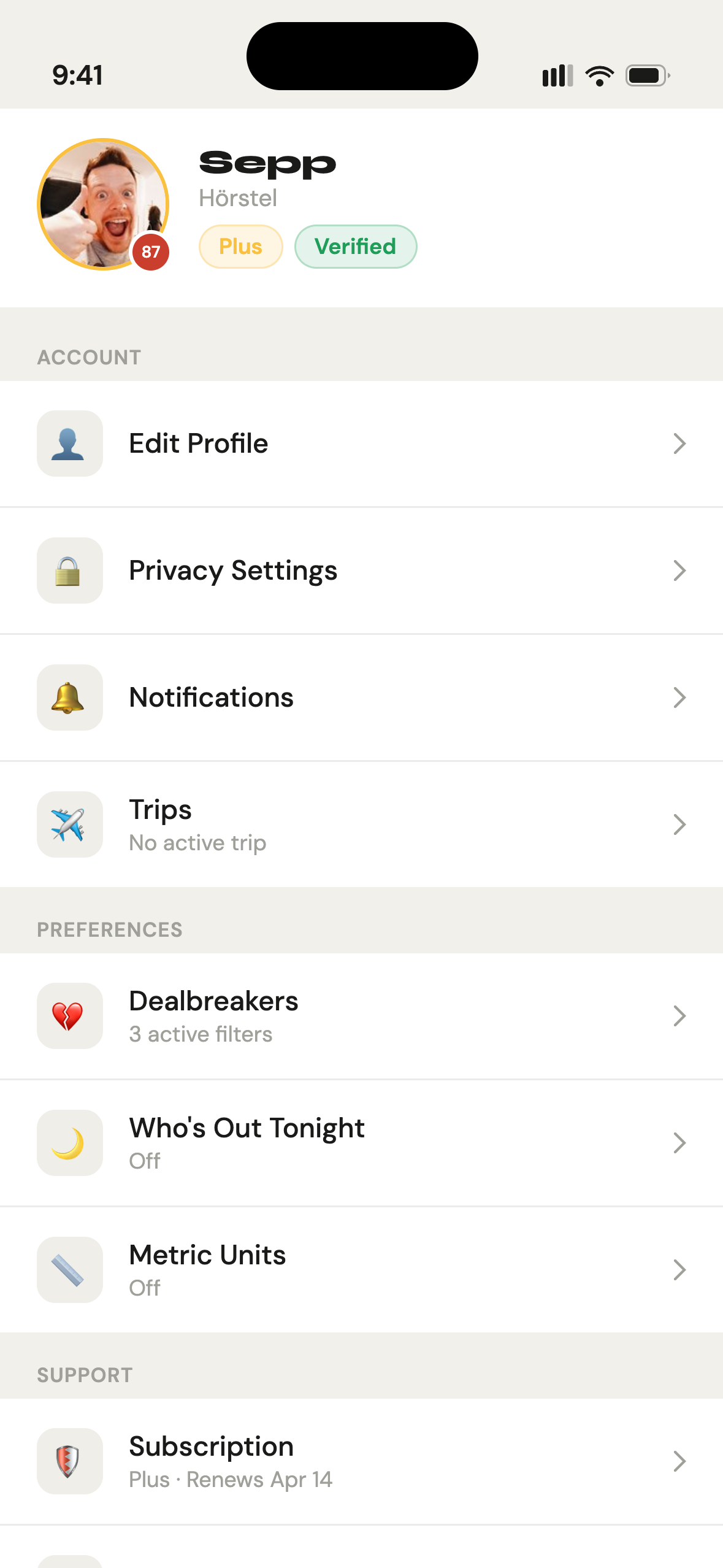
Identity verification is mandatory for every user, at every tier. There is no unverified account on Gettit. Every profile that appears in your grid passed an identity check — a live selfie matched against a identity verification — before going live. This eliminates bots, makes catfishing dramatically harder, and creates real accountability for user behavior because every account is tied to a real identity.
Location fuzzing is built into the core product. Gettit never displays or stores your exact coordinates. The proximity grid shows approximate distance, and the precision of that display is intentionally limited. Triangulation attacks aren’t possible because the location data itself isn’t precise enough to exploit.
Incognito Mode (Plus) lets you browse without appearing in others’ grids. For users in areas where being visibly on a queer dating app carries risk — visiting family in a conservative area, traveling internationally, early in the coming-out process — this is a meaningful safety feature.
No data selling. Gettit’s business model is subscription revenue. It doesn’t sell orientation data, location history, or usage patterns to advertisers or data brokers. GDPR and CCPA compliance is built in, not bolted on.
24/7 moderation. Harassment reports are reviewed around the clock. Repeat offenders face account termination, and because every account requires identity verification and payment, creating a new account after a ban is a real barrier rather than a 30-second workaround.
Practical Safety Tips for Any App
Regardless of which app you use, these practices reduce risk:
- Use a profile photo that isn’t indexed elsewhere. Reverse image search makes it easy to connect a dating app photo to other social media accounts. Use a photo that isn’t on your public Instagram or LinkedIn.
- Don’t share your exact address via chat. Suggest a specific public place for a first meeting rather than sharing your home or work location.
- Tell someone where you’re going. A simple check-in plan — “I’ll text you by 9pm” — adds a layer of accountability to any in-person meeting.
- Review app permissions on your phone. Most apps request continuous location access. “While using the app” is sufficient; deny background location access on any dating app.
- Report aggressively. Reporting bad actors protects the whole community. Even if you don’t expect the platform to act immediately, the data from reports informs moderation decisions.
The Bottom Line
For LGBTQ+ users prioritizing safety, the app hierarchy looks roughly like this: Gettit leads on structural safety (mandatory verification, location fuzzing, Incognito Mode, no data selling). HER leads for women and nonbinary users who value community over features. Scruff is a reasonable choice for gay and queer men who need broad reach and want to avoid Grindr’s privacy record. Taimi is worth monitoring as its verification system matures. Grindr remains the largest app and the one with the most documented safety concerns — use it with eyes open, and treat its location data as public information.
A safe LGBTQ dating app isn’t just about features on a checklist. It’s about whether the platform’s business model aligns with your privacy, whether verification creates real accountability, and whether you can control who sees you. Those questions have different answers on different platforms — and the answers matter.
Gettit’s beta is open now for New York City users, with Plus access free for six months for early testers.
Ready to Meet Real People?
Join the Gettit beta and get 6 months of Plus free.
Sign Up Now — 6 Months Free