How Gettit Protects Your Location Privacy — And Why That Matters
January 12, 2026 — By Gettit Team · 8 min read
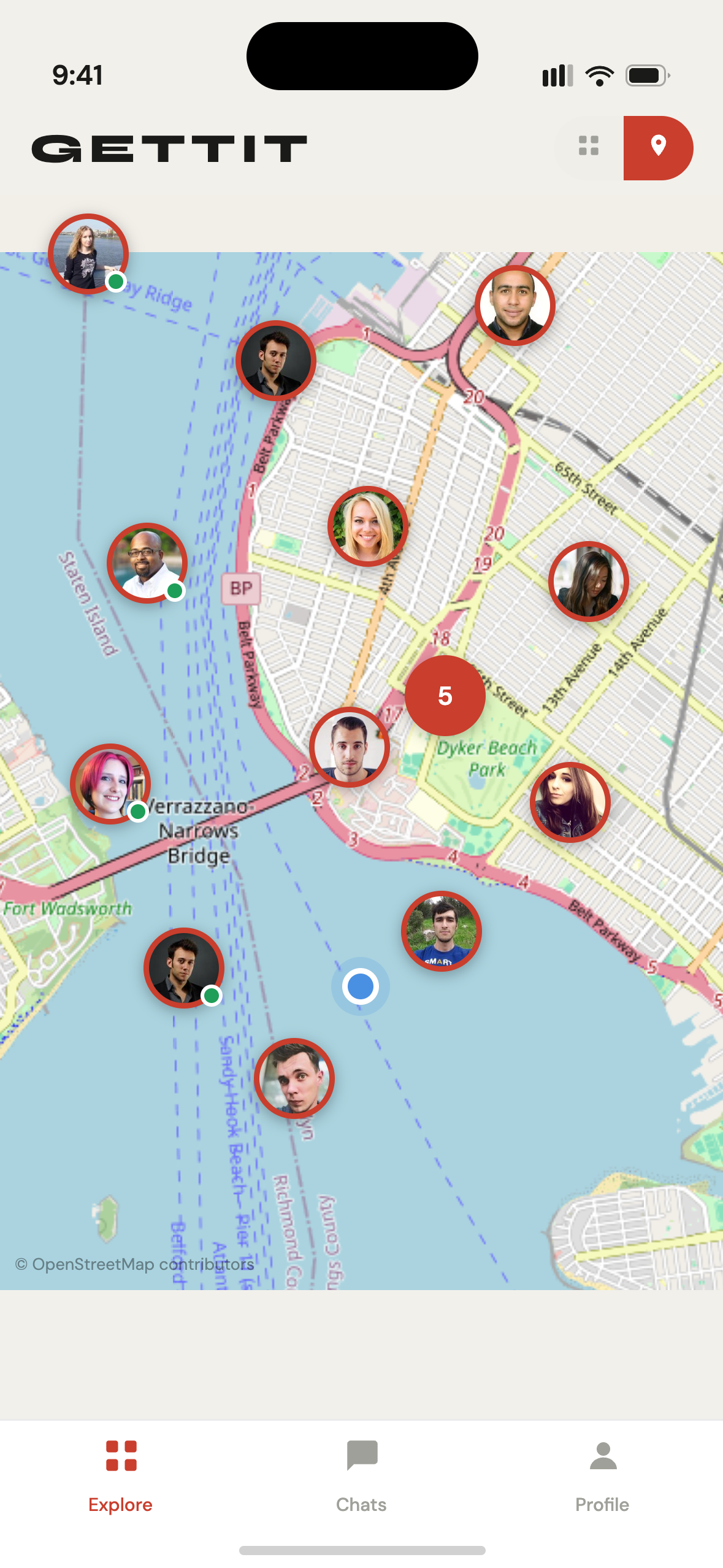
Dating app location privacy is the gap between what users assume and what apps actually do. Most people believe that showing a “2.1 miles away” distance means the app is only sharing a rough proximity. In many cases, they’re wrong. The distance display is fuzzy. The underlying data collection often is not. And that distinction has caused real harm to real people — stalking cases, domestic abuse incidents, outing of LGBTQ+ users in unsafe areas, and targeted harassment of people whose dating app profile was the only way someone knew they were in a particular neighborhood.
How Location Data Gets Misused on Dating Apps
The risks of precise location data aren’t hypothetical. Several high-profile incidents illustrate exactly how this plays out.
Grindr became the most documented example of location exposure when security researchers demonstrated that its API returned exact GPS coordinates for each user — accurate to within a few meters. By querying the API from three different positions, a researcher could triangulate a user’s precise location even when the app displayed only a rounded distance. This is called a trilateration attack, and it works on any app that provides high-precision underlying coordinates even if the front-end display is rounded.
Tinder had a separate incident in which a bug exposed user locations to within 100 feet despite displaying only mile-rounded distances. The bug was patched, but it demonstrated that front-end display rounding is not the same as backend location privacy.
Even apps that have addressed these specific bugs often retain granular location history on their servers — a different kind of risk. Data breach exposure, government subpoenas, or sale of the company can all bring that stored history to light in ways users didn’t anticipate.
The groups most at risk from precise location exposure are predictable: domestic abuse survivors whose abuser knows what dating apps they use, LGBTQ+ users in areas where being visibly queer carries risk, and anyone whose physical safety depends on not being findable at a specific time and place. For LGBTQ+ users specifically, choosing a safe LGBTQ+ dating app that builds privacy into its architecture — rather than adding it as an afterthought — matters significantly.
What “Location Fuzzing” Actually Means
Location fuzzing is the practice of introducing deliberate imprecision into the location data that an app stores, transmits, and displays — so that even if someone intercepts the data, they can’t derive a precise location from it.
The concept is straightforward to describe in non-technical terms. Instead of recording “user is at 40.7484° N, 73.9967° W” (a coordinate accurate to within a few feet), a fuzzing system records something like “user is within a 0.5-mile radius of a point that may itself be offset from their actual position.” Downstream from that, any distance calculation, API response, or display derived from that data carries the imprecision with it. You cannot reconstruct the exact original location because it was never stored.
This is fundamentally different from rounding a displayed distance while keeping the precise coordinate in the database. Rounding the display is cosmetic. Fuzzing the underlying data is structural.
How Gettit Handles Location
Gettit’s approach to dating app location privacy is built around three principles:
Fuzzing happens before storage. When the Gettit app records your location, it applies a randomized offset before writing anything to the backend. The precise coordinate never reaches the server. This means that even if the server were compromised, there would be no precise location data to retrieve — it simply doesn’t exist in the system.
Distance is displayed as an approximate radius, not a precise figure. When another user sees “nearby” in the proximity grid, they’re seeing a rounded distance derived from already-fuzzed data. The compounding of two layers of imprecision means trilateration attacks produce results too coarse to be useful. There is no precision to triangulate.
Location updates are periodic, not real-time. Some apps update your displayed location continuously as you move, which allows someone monitoring the app to track movement patterns over time. Gettit updates location data at intervals rather than in real time, which breaks the ability to derive movement patterns from the app’s distance display.
The practical result is that no one using Gettit — including the platform itself — can determine your exact location from the data the app generates. You’re findable by people who are nearby, which is the point of a proximity-based app. You’re not findable at a precision that enables tracking.
Incognito Mode: Removing Location Presence Entirely
For users who need a stronger level of location privacy, Gettit Plus includes Incognito Mode. When Incognito is active, your profile doesn’t appear in anyone else’s proximity grid at all. You can browse and see who’s nearby without being visible yourself.
The use cases are specific but important. A user visiting family in a region where being on a queer dating app would create danger can enable Incognito for the duration of the trip. Someone early in their coming-out process who isn’t ready to be visible to mutual connections can browse without risk of being seen. A user in a small town where everyone knows everyone can choose when they’re visible and when they’re not.
Incognito Mode doesn’t mean the app has no record that you exist — your account still exists and you can still initiate conversations. It means you’re not broadcasting your presence to the grid around you unless you choose to.
Your Location Permissions on iOS and Android
Regardless of which dating app you use, you have control over what location data the app can access at all. A few practices worth implementing:
On iOS: Go to Settings > Privacy & Security > Location Services. Find each dating app and set it to “While Using the App” rather than “Always.” This prevents background location collection — the app can only read your location when it’s open on screen.
On Android: Go to Settings > Apps > [App name] > Permissions > Location. Set it to “Only while using the app” and disable “Use precise location” if the option appears. Precise location access gives the app GPS-level accuracy; disabling it falls back to network-based location, which is less precise.
On both platforms: Review which apps have location access at all. Apps you haven’t opened in months can still have standing location permissions. Revoke access for apps you don’t actively use.
These settings limit what data goes into an app’s system in the first place — a complement to whatever the app does with that data once it has it.
Why This Matters Beyond Gettit
Dating app location privacy is an industry problem, not a Gettit problem to solve alone. The broader pattern is that apps are incentivized to collect precise location data because that data has advertising value, and the cost of a data breach or misuse is borne by users, not by the platform. This connects directly to why dating apps with verified profiles that pair identity verification with privacy-first architecture represent a different class of product from the mainstream options.
Regulatory frameworks are starting to address this. GDPR in Europe and CCPA in California both impose requirements around location data minimization — collecting only what is necessary for the service’s stated purpose, and retaining it only for as long as necessary. Enforcement is inconsistent, but the legal exposure for apps that collect gratuitous location data is growing.
The practical implication for users is to treat location data as something to protect, not just something to share by default. The distance display is not the same as the underlying data. The “While Using the App” permission is meaningfully different from “Always.” And choosing an app whose location privacy architecture is designed from the ground up — rather than patched after a breach — makes a real difference.
Gettit’s beta is open for New York City users. Location fuzzing and proximity-based discovery are available at every tier, with Incognito Mode included in Gettit Plus.
Ready to Meet Real People?
Join the Gettit beta and get 6 months of Plus free.
Sign Up Now — 6 Months Free