The Anti-Ghosting Dating App: How Accountability-Based Matching Changes Dating
March 23, 2026 — By Gettit Team · 9 min read
“Anti-ghosting dating app” gets used as a marketing claim fairly often. Apps gesture at it with features like match expiry timers or prompts to respond to pending conversations. But most of these are surface-level interventions — small nudges layered on top of a platform architecture that still fundamentally enables and even rewards the behavior they claim to be fighting. Real accountability-based matching isn’t a feature. It’s a design philosophy that has to be threaded through every layer of how the product works, from how users verify their identity to how mutual interest is signaled to how reputation information is surfaced. When all of those layers are aligned, the result is an experience that actually leads to fewer ghosts and more real dates. When one or two features are bolted onto a swipe-culture foundation, the result is noise.
Gettit is built from the ground up as an anti-ghosting dating app — not because the word tests well in user research, but because every significant product decision was made with the explicit question: does this create accountability, or does it undermine it? Here’s what that actually looks like in practice.
Pillar One: Identity Verification
The most foundational accountability mechanism isn’t a feature at all — it’s an entry requirement. Before a Gettit profile becomes visible to anyone else on the platform, the user must verify their identity with a live selfie verification check. The system confirms the face is genuine and the identity is real. Every profile in the active user pool has cleared this bar. For a platform-by-platform comparison of what “verified” actually means, see our guide to dating apps with verified profiles.
The accountability effect of mandatory identity verification operates at a psychological level that app designers sometimes underestimate. When you know that your real name and verified age are attached to your profile — not a username, not a pseudonym, but information that corresponds to who you actually are — the social stakes of your behavior on the platform feel different. Ghosting a verified person, whose real-world identity you share by implication of mutual verification, carries more psychological weight than disappearing from an anonymous swipe deck. It feels closer to blowing off someone at a party than it does to abandoning a browser tab.
This isn’t a guarantee against ghosting — human behavior is more complex than any single design intervention. But it shifts the baseline. The absence of anonymous, consequence-free interaction changes the culture of an app more than any downstream feature can.
Pillar Two: The Response Rate Badge
Every Gettit profile, from the first day a user joins, begins building a Response Rate — a measure of what percentage of incoming messages they actually reply to. This rate is displayed on their public profile, visible to anyone considering sending them a message.
This single feature creates two distinct accountability loops simultaneously.
For the profile owner, it creates a reputation-based incentive to be responsive. If your Response Rate sits at 22%, anyone looking at your profile sees that you’re unlikely to reply. If it’s at 81%, that’s a visible signal of engagement and good faith. Most people, given the choice, would prefer to be seen as someone who shows up — and that preference translates into more consistent response behavior when the information is public. The Response Rate Badge rewards exactly the behavior the entire platform ecosystem needs: people actually responding to messages.
For the person deciding whether to send a message, it provides honest information that was previously completely unavailable. You have no way to know, on Tinder or Hinge, whether your match has been active in three days or three months, or whether they respond to half their messages or five percent of them. The Response Rate Badge makes that information available upfront, allowing users to direct their time and energy toward connections with a higher probability of actually going somewhere.
Note that the Response Rate Badge is part of the Base plan — it applies to every profile on the platform regardless of subscription tier. This was a deliberate decision. An accountability feature that only applies to some users doesn’t create a consistently accountable ecosystem. For it to change platform culture, it needs to be universal.
Pillar Three: Who Viewed Me
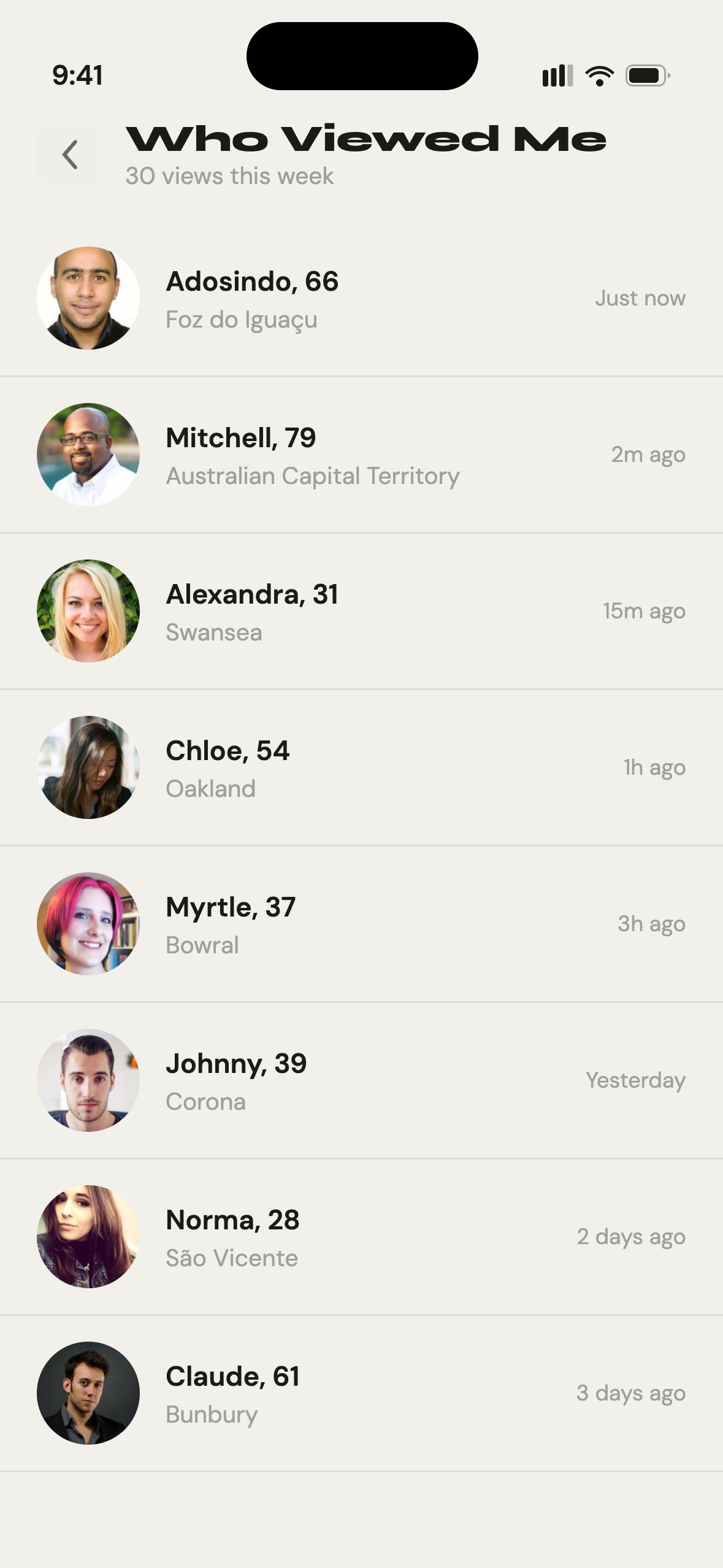
Who Viewed Me is a Gettit Plus feature that shows you which profiles have visited your profile in a given window. At first glance, this might seem like a vanity feature — a way to see who’s been looking. In practice, it’s an accountability mechanism disguised as a discovery tool.
The one-sided anonymity of profile browsing on most dating apps creates a specific kind of passive non-commitment: you can look at someone extensively, feel genuine interest, and never do anything about it because they’ll never know you were there. The cost of inaction is zero. The cost of action — messaging someone — involves vulnerability and the risk of rejection. When the asymmetry between those costs is extreme, most people choose inaction most of the time.
Who Viewed Me shifts that dynamic by creating mutual awareness of interest. When you know that someone has looked at your profile, there’s a natural opening for connection that didn’t exist before. The ice is already partially broken — they were curious enough to visit, and now you both know it. For the person who viewed, the awareness that their visit might be visible creates a slight incentive to follow through if they were genuinely interested, rather than browsing passively with no intention of acting.
The combined effect is that more genuine interest converts into actual conversations. Interest that previously died in the anonymous browsing phase gets a mechanism to surface and become real.
Pillar Four: The Spark Match System
Ghosting most commonly occurs in the gap between “match” and “real conversation” — a gap that on swipe-based apps is enormous and filled with ambiguity. You matched, but did you match because they swiped right on everyone, or because they were actually interested? You can’t know, so the first message carries a disproportionate weight of uncertainty, and the person on the other end has no particular reason to feel invested in responding because they may not even remember you.
Gettit’s Spark Match system is designed to collapse that gap by requiring a clearer mutual signal before a connection is made. When both users have independently expressed interest — a mutual Spark — the match carries a different psychological charge than a low-friction swipe match. Both people know the other person was specifically interested, not just swiping broadly. That shared knowledge creates a starting condition where both parties feel a basic level of investment in the connection, which changes how the first conversation begins and how much effort both sides put into keeping it going.
The mutual signal also has a ghosting-reduction effect that comes from commitment consistency — a well-documented principle in behavioral psychology. Having actively indicated specific interest in someone creates a small but real internal pressure to follow through. Ghosting the person after expressing genuine interest requires a deliberate contradiction of your stated preferences, which most people find uncomfortable enough to avoid.
Why Most Apps Don’t Do This
It’s worth asking why, if accountability-based matching produces better outcomes for users, the dominant apps haven’t implemented it. The answer is uncomfortable but straightforward: building in accountability reduces the engagement metrics that drive platform revenue.
A user who quickly finds a good match and goes on a date opens the app less, buys fewer premium features, and may delete the account entirely. A user who is perpetually almost-but-not-quite connecting — who has fifty matches and no real conversations — opens the app constantly looking for the connection that hasn’t materialized yet. That user is enormously more valuable to a platform monetized by subscription and in-app purchases.
Response Rate Badges, mandatory verification, and features that make ghosting socially costly all push users toward the outcome that’s good for them and bad for the platform’s engagement numbers. It’s a genuine conflict of interest between user outcomes and product metrics, and most established apps have resolved it in favor of the metrics.
Gettit’s thesis is that this is the wrong resolution — that the long-term value of a platform where users reliably find real connections outweighs the short-term engagement revenue from a frustrated user pool. The business model is straightforward: Gettit Base at $0.99/month and Gettit Plus at $9.99/month. No ad revenue, no incentive to keep users anxious and single, no conflict between what’s good for you and what’s good for the company.
Anti-Ghosting as a Design Philosophy
The common thread across all four pillars is that accountability-based matching isn’t any single feature — it’s a commitment that runs through every product decision, from the entry requirements for creating a profile to the information displayed on each one to the way mutual interest is signaled and made visible.
An app that adds a response reminder notification on top of an anonymous, unverified, swipe-based ecosystem has not become an anti-ghosting app. It has added a notification. The underlying culture — where profiles may or may not be real, where matching is frictionless and consequenceless, where no one can see how you’ve behaved toward previous matches — is unchanged.
The culture of a dating app is almost entirely downstream of its design. Apps that design for accountability produce more accountable users. Apps that design for engagement produce more engaged-but-frustrated users. The question of which one you’re using is the most important thing to know before you send your first message.
Gettit’s beta is open in New York. Every design decision it has made was made with the question of accountability in mind. Come see what that actually feels like. For background on why ghosting is so persistent in the first place, read Why People Ghost on Dating Apps.
Ready to Meet Real People?
Join the Gettit beta and get 6 months of Plus free.
Sign Up Now — 6 Months Free