Why End-to-End Encryption Matters in a Dating App
April 7, 2026 — By Gettit Team · 8 min read
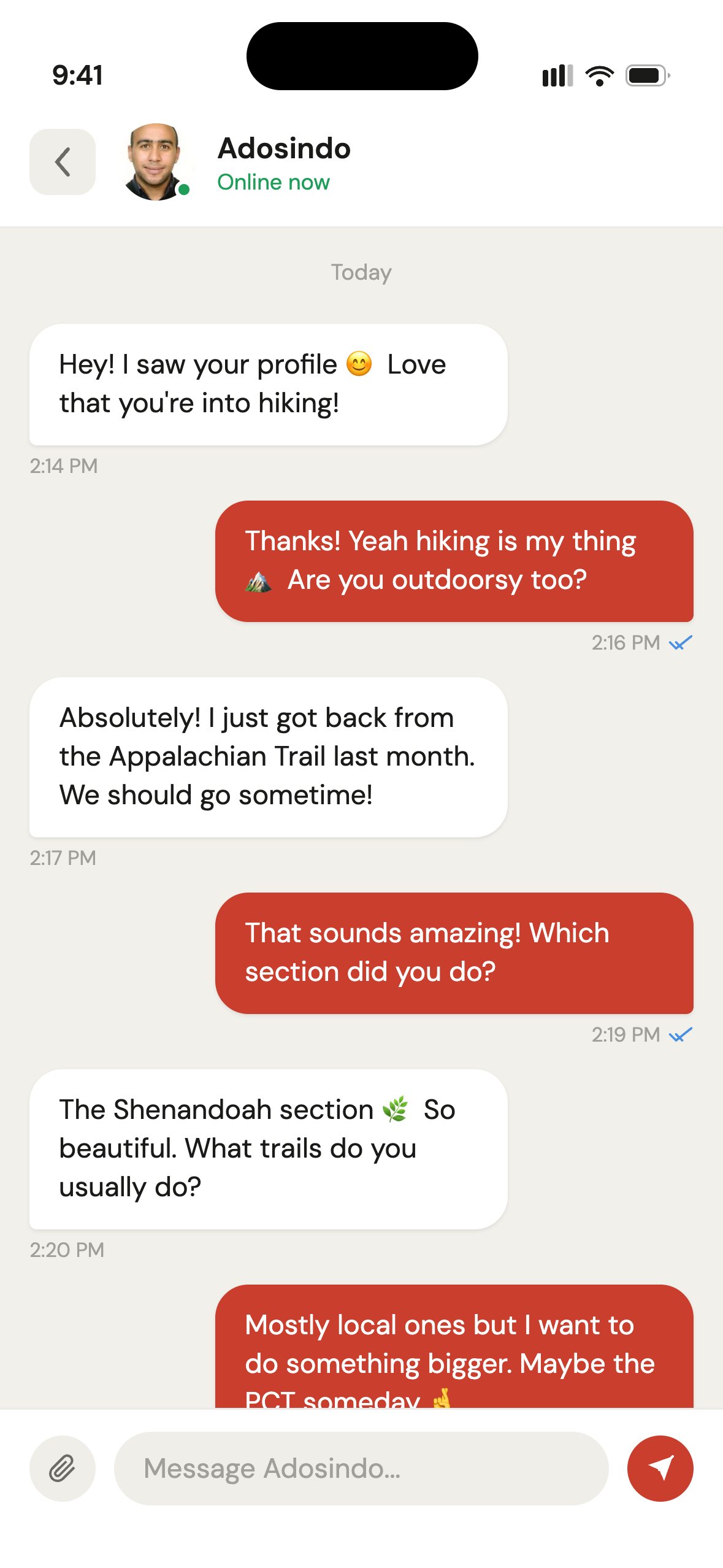
When you send a message on a dating app, where does it go?
The answer, for most apps, is: through their servers, stored in their databases, readable by their engineers, and potentially accessible to anyone who gets unauthorized access to those systems. That’s the default. Most dating apps are built this way — not out of malice, but because it’s simpler and cheaper, and most users never think to ask.
End-to-end encryption changes the entire model. And for a dating app — where conversations are deeply personal, sometimes vulnerable, and often shared between people who are still strangers — it should be the standard, not the exception.
What End-to-End Encryption Actually Means
Encryption, in the broadest sense, means scrambling data so it can only be read by someone with the right key. Most apps encrypt data “in transit” (while it travels between your phone and their servers) and “at rest” (while it sits on their servers). This is better than nothing, but it still means the company holding your data can decrypt and read it.
End-to-end encryption is fundamentally different. The message is encrypted on your device before it leaves, and it can only be decrypted on the recipient’s device. The server in the middle — the infrastructure handling delivery — never sees the plaintext. It can’t. The keys don’t exist anywhere except on the sender’s and recipient’s devices.
The practical implication: even if someone breaches the server, they get encrypted ciphertext. Even if a company employee looks up your conversation in the database, they see garbage. Even if a government subpoena demands your messages, the company can hand over data they genuinely cannot read.
Why This Matters More on a Dating App
Dating conversations are uniquely sensitive. They contain things you might not put anywhere else:
- Attraction and vulnerability, shared before you know if you can trust someone
- Health information, sometimes including sexual health details, shared in the context of potential intimacy
- Location and schedule information (“I’m usually around Williamsburg on Saturday nights”)
- Photos sent in the expectation of privacy
- Conversations that reveal orientation, relationship status, or details you may not be out about publicly
The consequences of these conversations being exposed — through a breach, a disgruntled employee, a legal request, or a platform acquisition — are real. People have been outed, stalked, blackmailed, and harassed through data that dating apps held.
Most major dating apps do not use end-to-end encryption for messages. Your conversations with matches on the most popular apps are sitting in a readable database somewhere.
How Gettit’s Messaging Is Built
Every conversation on Gettit is end-to-end encrypted by default. There’s no setting to turn on, no premium tier required — it’s the foundation the messaging system is built on.
When you open a chat, your device and your match’s device perform a cryptographic handshake that establishes a shared secret. Messages are encrypted on your device before transmission. The delivery infrastructure handles routing without ever seeing message content. Decryption only happens on the recipient’s device.
This architecture is also why certain features work the way they do. Read receipts and typing indicators are handled through a separate real-time presence layer — lightweight signals that don’t require touching message content. Disappearing messages (available on Gettit Plus) work client-side: the retention timer is enforced on both devices, and there’s no server-side copy to delete because the server never stored plaintext to begin with.
The tradeoff is real: end-to-end encrypted messages cannot be recovered if you lose access to your device and haven’t backed up your keys. We think that’s the right tradeoff. A system where we could recover your messages is a system where we — or someone else — could read them.
What E2E Encryption Doesn’t Cover
It’s worth being precise about what end-to-end encryption protects and what it doesn’t.
It protects: the content of your messages — the text, photos, and files you send back and forth.
It doesn’t protect: metadata. Who you’re talking to, how often, and at what times — this information exists at the infrastructure level and is handled separately under our privacy policy. We minimize what metadata we retain, but “zero metadata” would require a fundamentally different kind of infrastructure that would make basic features like notifications and match management impossible.
It doesn’t protect: what you screenshot or share outside the app. End-to-end encryption keeps your conversation private from third parties; it doesn’t prevent your match from taking a screenshot. This is why Gettit’s identity verification matters in concert with encryption — you’re not just protected from external threats, you’re connected with verified real people who have real social accountability.
It doesn’t replace: good judgment about what you share and when. Encryption is a structural protection, not a substitute for building trust gradually.
The Industry Should Be Doing This Already
The gap between what’s technically possible and what dating apps actually implement is significant. End-to-end encrypted messaging is a solved problem — the cryptographic protocols are mature, the open-source implementations are well-audited, and the engineering cost is manageable. The reason most dating apps haven’t implemented it isn’t that they can’t; it’s that they haven’t prioritized it.
Some platforms have legitimate reasons to access message content — safety moderation, for instance. This is a real tension: end-to-end encryption means you can’t scan messages for CSAM or harassment. Gettit’s approach to this tradeoff is to focus content moderation on profile images, public-facing elements, and reported content rather than surveilling private conversations. Our CSAE policy explains our approach to child safety in detail.
The broader industry argument — that access to message content is necessary for safety — often papers over a simpler truth: companies that can read your messages have more data, and more data is more valuable. Privacy and monetization pull in opposite directions.
Encryption Is Table Stakes, Not a Feature
The framing of end-to-end encryption as a premium feature or a differentiator says something uncomfortable about where the industry has set the bar. It should be table stakes. A platform that handles the intimate conversations of millions of people — who are often sharing vulnerability with near-strangers — has an obligation to protect that data structurally, not just administratively.
At Gettit, encryption isn’t listed in our feature comparison table. It’s not a selling point — it’s the foundation. The same way you wouldn’t advertise that a safe has a lock, we don’t advertise that our messages are private. They simply are.
What we do advertise is what we’ve built on top of that foundation: identity verification, Response Rate Badge, location fuzzing, and the features that make the experience of actually connecting with someone better. Privacy is the floor. Everything else is the building.
If you’re thinking about what you’re sharing on a dating app and who can see it — you should be. Start by choosing apps that take that question seriously.
Ready to Meet Real People?
Join the Gettit beta and get 6 months of Plus free.
Sign Up Now — 6 Months Free